
- Level:
- Novice
- Lessons:
- 14 Lessons
Developing Theme from Genre
Turn abstract genre conventions into a central thematic question to shape your characters and world.
- Reading Time
- approx. 4 min
In the last lesson, you customized a genre and blended it with another to create a unique story concept. You might have a setting, a genre, and a general idea of the “vibe.”
However, you might feel like you have a collection of cool ideas that don’t quite fit together yet. A guild of artisans, a fading magic system, and a thriller plot are great ingredients, but what actually holds them together?
That glue is Theme.
Key Takeaways
- Genre conventions often point toward common themes you can use, subvert, or combine.
- Framing your theme as a central question gives your story a clear through-line to explore.
- Theme can inspire distinct character arcs and world-building details that reinforce your story’s meaning.
This lesson focuses on applying the theme practically. If you want a deeper dive into the theory of theme, check out our standalone lesson: Introduction to Theme.
Taking Inspiration from Genre
Just as genres have expected plot points and tropes, they also have expected themes. Readers often gravitate toward specific genres because they want to explore specific types of emotional or philosophical problems.
- Romance: often explores Love vs. Fear, or Individual vs. Partnership.
- Sci-Fi: often looks at Humanity vs. Technology, or Free Will vs. Determinism.
- Fantasy: often deals with Good vs. Evil, or Tradition vs. Progress.
You can use these common themes as a shortcut. You don’t need to reinvent the wheel; you can take a classic theme and twist it to fit your specific story.
My story is a Mid-Fantasy about magical artisans. Common themes in this genre include tradition vs innovation, identity and belonging, and class inequality.
Looking at my “anti-premise” from the last lesson (magic has strict costs), I want to explore the theme of Duty vs. Desire. My characters are artisans bound to their craft, but they likely have personal dreams that conflict with the demands of their job.
Defining Theme as a Central Question
Avoid thinking of the theme as a moral statement, like “Love conquers all” or “Crime doesn’t pay.” This often leads to stories that feel preachy, predictable, or one-sided.
Instead, try framing the theme as a central question.
A question forces the story to explore a topic from different angles. It allows the characters—and the reader—to struggle with the answer, rather than being told what to think. A good thematic question does not have a simple “Yes” or “No” answer.
Here are a few examples of how to turn a generic topic into a compelling question across different genres:
- Sci-Fi: “Humanity vs. Technology” → “Does creating artificial life make you responsible for its soul?”
- Romance: “Love vs. Identity” → “How much of your individual identity should you compromise for a relationship?”
- Thriller: “Justice vs. Revenge” → “How far can you go to stop a monster before you become one yourself?”
By framing the theme this way, the story becomes a debate rather than a lecture.
Broad Theme: Duty vs. Desire.
Thematic Question: “Is it selfish to want something for yourself when the community depends on you?”
Thematic questions immediately suggest conflict. Some characters might say yes, others no. Some might change their answer by the end of the story.
Building Character Arcs from Theme
With a central question, you can create characters who have different answers to it. This creates natural conflict.
In the Character Arcs lesson, the concept of positive, flat, and negative arcs are discussed. You can assign these arcs based on how a character reacts to your thematic question. The goal is variety—different perspectives create conflict and debate within the story.
Let’s look at three characters in the guild. Each has a different relationship with the thematic question:
- Character A, Garrick: They believe the answer is Yes. They buried their own dreams years ago to serve the guild. They represent “Duty,” but are bitter and regretful. Their arc might be about rediscovering what they actually want.
- Character B, Ocher: They believe the answer is No. They want to use their magic for their own art, not for the city’s utility. They resent that their talent is “owed” to society. Their arc explores whether pursuing that desire makes them selfish or brave.
- Character C, Fia: They are torn. They inherited an obligation to serve. They are the character who struggles the most with the question throughout the story. Their arc might force them to decide: stay out of guilt, or leave and face the consequences?
When your characters disagree about the central question, you get natural conflict without needing an external villain to manufacture drama.
Using World-Building to Reinforce Theme
Theme isn’t limited to what characters say or think. It can exist physically in your setting. The locations, objects, and lore of your world can act as physical symbols of your theme.
Consider how location, culture, and even objects can embody thematic ideas:
- A story about isolation might be set in a remote lighthouse or a generation ship drifting between stars.
- A story about social decay could unfold in a crumbling, once-grand city where the architecture itself tells a story of lost glory.
- A story about memory and loss might feature a world where physical objects literally hold the memories of their previous owners.
For my story, I want the world to force the characters to think about Duty. How does the world represent the conflict between what you want and what you must do?
- Contracts: Magic isn’t just a skill; it requires signing a literal, binding contract with the city/guilds. Breaking it has consequences.
- The “Gray” Market: A literal underground market where people trade “unregistered” magical items—things made for beauty or fun rather than utility. This represents “Desire.”
Stress Testing with AI
If you’re struggling to find a unique angle on your theme, AI can help challenge your assumptions. You can use it to “stress-test” the theme. Try asking an AI chatbot to argue against the premise or act as a literary critic.
I am writing a mid-fantasy story about a guild of magical artisans. My central thematic question is: “Is it selfish to want something for yourself when the community depends on you?”
Please act as a literary critic. Analyze this theme and suggest:
- Three ways this theme could be interpreted clichédly (so I can avoid them).
- Three alternative, darker interpretations of this question.
- A “counter-argument” the villain might make.
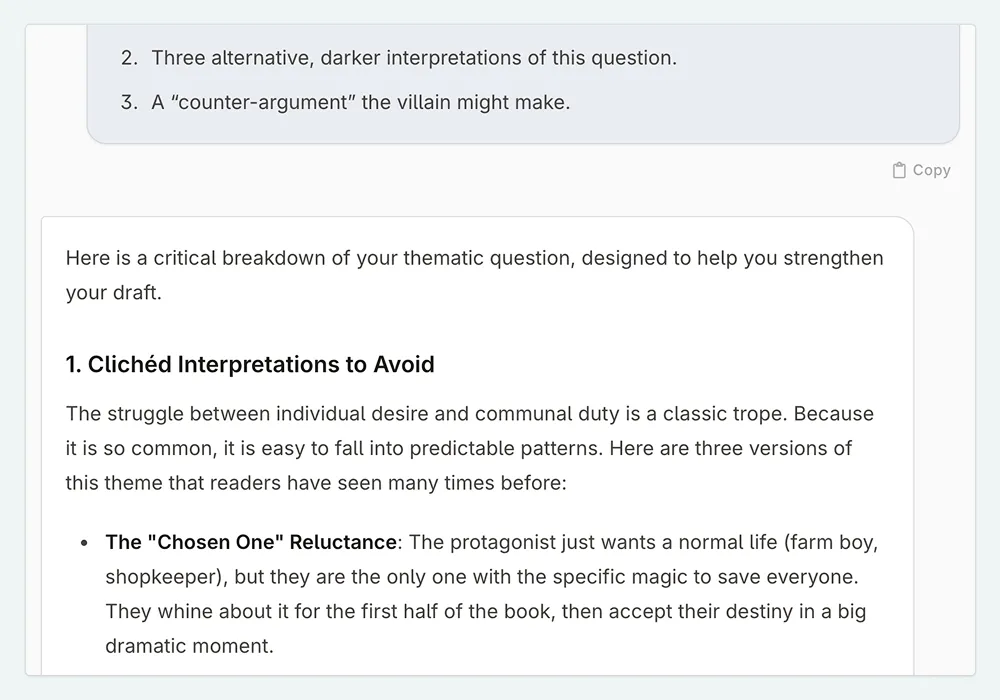
By seeing the clichés, you know what to avoid. By seeing the villain’s argument, you gain a better understanding of the conflict. You could also ask for alternative interpretations, or to have contradictions pointed out to you.
Recap
In this lesson, you connected our scattered ideas using a theme, and how to take a genre convention and turn it into a thematic question.
This was then applied to characters, giving them opposing viewpoints, and to our world-building, creating physical representations of the internal conflict.
Your story now has a genre, a unique theme, and some basic world building. In the final part of the genre section, we will set the stakes in preparation for writing a story premise.
This lesson was taught by:

Kate
Based in the UK, Kate has been writing since she was young, driven by a burning need to get the vivid tales in her head down on paper… or the computer screen.