
- Level:
- Novice
- Lessons:
- 14 Lessons
Building the World Around Your Detail
Answer the questions your seed detail raised by building a focused, layered world.
- Reading Time
- approx. 4 min
You have a detail and a chain of questions. Now we answer them.
The instinct when world-building is to build wide: maps, calendars, political systems, entire histories. We’re going to resist that. Instead, we build narrow and deep. Everything connects back to the seed detail. If a piece of world-building doesn’t serve the detail, it waits.
Key Takeaways
- Build your world in three layers: Practical, Historical, and Social.
- Only build what the detail demands — resist the urge to over-expand.
- Use AI to interview yourself about the parts of the world you haven’t considered yet.
The Guiding Principle: Build from the Seed
Every piece of world-building in this lesson should connect back to your seed detail within one or two steps. If you’re writing about frost boundaries and you catch yourself designing the royal court three kingdoms over, stop. That might matter later. It doesn’t matter now.
This focus is what makes world-building useful rather than just fun. We want a world that generates stories, not an encyclopedia.
The Three Layers
Work backward from your detail using three layers. Each one addresses a different type of question.
Practical: How does it work? The physical, observable properties. Can people see it, touch it, interact with it? What are its limits? Even in fantasy, the reader needs to understand how a detail behaves before caring what it means.
Historical: How did it get here? The origin. Was it always here, or do people remember a time before? Is it stable, or is it changing? A past implies change, and change implies story.
Social: How do people live with it? How has the community adapted? Economy, routines, beliefs. Who benefits and who doesn’t. Who has power because of it.
Let’s build these out.
Practical:
- A visible line — green grass on one side, frost on the other. Roughly circular.
- Weakens in severe weather. After a bad storm, the edge recedes slightly before recovering.
- Has been shrinking slowly over the past decade. Not dramatically — a metre or two a year — but enough that people on the edge have noticed.
Historical:
- The village was founded because of the boundary. It predates every building.
- No one alive remembers its creation. The oldest written records already mention it.
- Two competing origin stories exist: one says it’s a blessing from the land itself; the other says someone made a bargain with something beneath the ground.
Social:
- The economy depends on the boundary. Crops that can’t grow in the surrounding frost thrive inside it, making the village a regional trade hub.
- Property value is tied to position. Land near the centre is expensive and safe. Land near the edge is cheap and precarious.
- One established family — the Hargraves — owns land at the centre and has unofficial authority over boundary-related decisions.
This works the same way outside speculative fiction:
Practical: It’s a specific recipe — thick, reddish, slightly sweet. Made fresh every morning. The ingredients are ordinary, but nobody has been able to replicate the taste.
Historical: The original owner, Maren, opened the diner in 1984. She served the soup from day one. When she disappeared in 1997, the lease passed to her sous-chef with one condition: the soup stays on the menu, made from her handwritten recipe card, every day the diner is open.
Social: The soup has become a local landmark. Regulars treat it like a ritual. Newcomers who suggest changing the menu are met with silence. The current owner has never altered a single ingredient — partly out of loyalty, partly because the lease says she can’t.
Using AI to Interview Yourself
In the lesson on developing theme from genre, we used AI as a brainstorming partner by asking it to pose questions about our ideas. The same approach works here, and it’s particularly useful for the Social layer — the part where blind spots tend to hide.
Describe your seed detail and your three layers to the AI, then ask it to interview you about what you might have missed.
Here is my seed detail and the world I’ve built around it so far:
[Add seed detail here]
[add answers about the three layers here]
Interview me about this world. Ask me questions about aspects I haven’t considered — especially about daily life, social tensions, and what happens to people on the margins of this system. Ask one question at a time, and wait for my answer before asking the next.
The key is the same as before: you answer the questions. The AI is the interviewer, not the author. By forcing yourself to respond, you’ll discover things about your world you didn’t know you’d already decided.
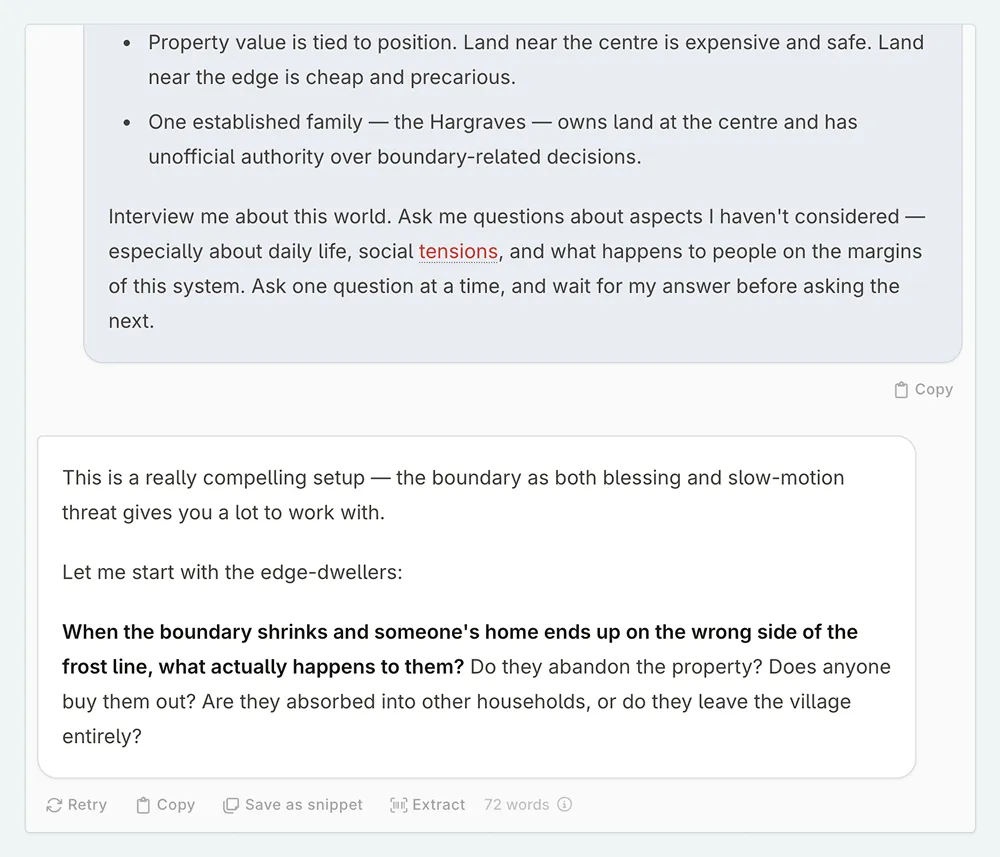

Before using this prompt, I hadn’t considered what happened to people whose homes were on the edge of the frost boundary. I knew the land was cheaper there, but I hadn’t thought about why.
My subsequent answer, that they’re offered charity housing, felt like a natural solution to the problem of people living in a risky area. It also created a new tension: the stigma of living on the edge, and the resentment from those who live near the centre who have to support their fellow townspeople.
The scenario reminded me of seaside towns susceptible to coastal erosion, and is exactly the kind of detail I was hoping to uncover with this exercise.
If you want a more guided experience, we’ve built a prompt for use in Novelcrafter:
Seed Detail Development
Learn how to add this prompt to your account here.
Recap
You’ve built a focused world in three layers, Practical, Historical, and Social, all radiating from your seed detail. You used AI to find the gaps in your thinking and filled them with answers that surprised you.
Your world now has structure. In the next lesson, we’ll look at the cracks in that structure, developing the tensions and fault lines that will generate your characters and your story.
This lesson was taught by:

Kate
Based in the UK, Kate has been writing since she was young, driven by a burning need to get the vivid tales in her head down on paper… or the computer screen.