
- Level:
- Novice
- Lessons:
- 14 Lessons
Capturing Story Ideas
Turn off your inner critic and explore various methods for coming up with new story ideas.
- Reading Time
- approx. 3 min
Do you ever get stuck on an idea because you’re worried if it’s “good enough”? In this lesson we’ll turn off our internal editor and focus on gathering as many ideas as possible, without judgment. We’ll sort through them in the next lesson.
Key Takeaways
- Create a Judgment-Free Zone. The goal is quantity, not perfection.
- When you’re stuck, prompt your imagination with techniques like asking “What if?” questions, mixing genres, or using external inspiration like music and images.
- Use AI as a brainstorming partner by having it ask you probing questions about your ideas.
Gathering Ideas
To encourage a free flow of ideas, it helps to have a dedicated place where you can be messy. This could be a physical notebook, a text file, voice dictation notes, visual boards, or a project inside Novelcrafter.
When brainstorming ideas, don’t worry about spelling, grammar, or whether an idea is “good.” Just get it down. If you try to organize them immediately, you risk stopping the creative flow.

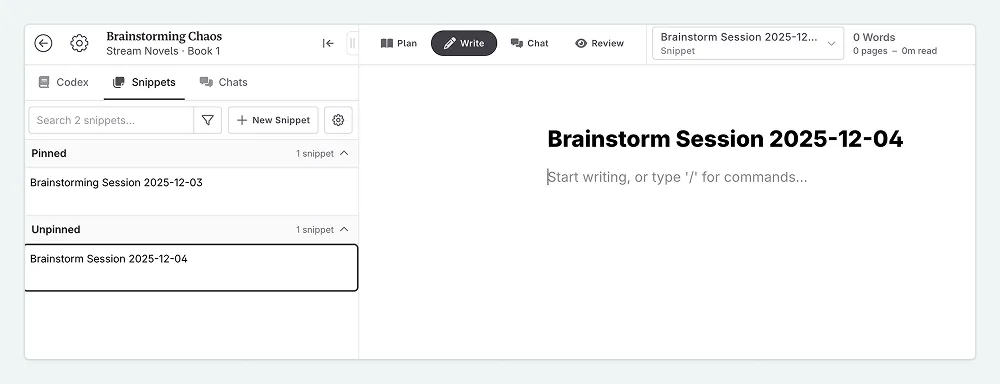
I like to create a blank project called “Brainstorming Chaos” in Novelcrafter. I add any and all ideas into a Snippet—a line of dialogue, a weird dream, a character name—for later perusal. See below for how my Novelcrafter project looked before I started putting down ideas.
Brainstorming Techniques
If you’re feeling stuck, you can use specific prompts to trigger ideas, or take inspiration from the world. Let’s look at a few ideas.
“What If?” Questions
Your daily life is full of story ideas, waiting to be noticed. Look around you and tweak one law of reality.
Observation: Outside my window, only part of the frost has melted.
My Idea: “What if there was a firm line in the village where frost stopped? No snow, no ice, just a clean, crisp division.”
Inspiration from Real Life
A great source of inspiration is looking at what people leave behind. Find an object that looks out of place and invent its history.
Observation: A single 2D silhouette of a cat, left out long after halloween.
My Idea: “Why is this still up? Is it a modern-day Gollum, obsessively protecting a treasure? Does it act as a guardian for the occupants? Was there once two cats?”
Mixing Concepts
Take familiar ideas and give them a twist to make them new. Take two genres or character archetypes that don’t usually belong together and combine them.
Mix-Up: A Western/Cyberpunk story
My Idea: Cowboys on robotic horses trying to hack a high-speed bank train.
Mix-Up: Explorer/Lover Character Archetypes
- Explorer - craves freedom and authenticity
- Lover - seeks intimacy and connection
My Idea: A pirate who is torn between their love of the sea (and freedom), and the dryad that they meet. Their conflict is the constant pull between the open seas and the person that is their home.
Using External Triggers
Sometimes, you need a nudge from an outside source to get your mind going.
- Music and Mood: Create a playlist that evokes a feeling—mystery, adventure, melancholy. Listen to it and write down any images, scenes, or characters that come to mind.
- Moodboards: Collate images that inspire you, and make a collage of key words, phrases, and moods they evoke. Use the images as prompts to kickstart your ideas.
- Research: Choose a topic that fascinates you (a historical event, a scientific theory, a specific job) and research it. Real-world facts and details are powerful fuel for fresh and believable story ideas.
Partnering with AI
A great way to develop an idea is to talk it through with someone. When a friend asks questions about your story, it forces you to fill in the blanks. You can use an AI to play that same role, without waking any of your friends up in the middle of the night. The key is to have the AI ask you questions when you describe your idea, rather than asking questions for it to answer.
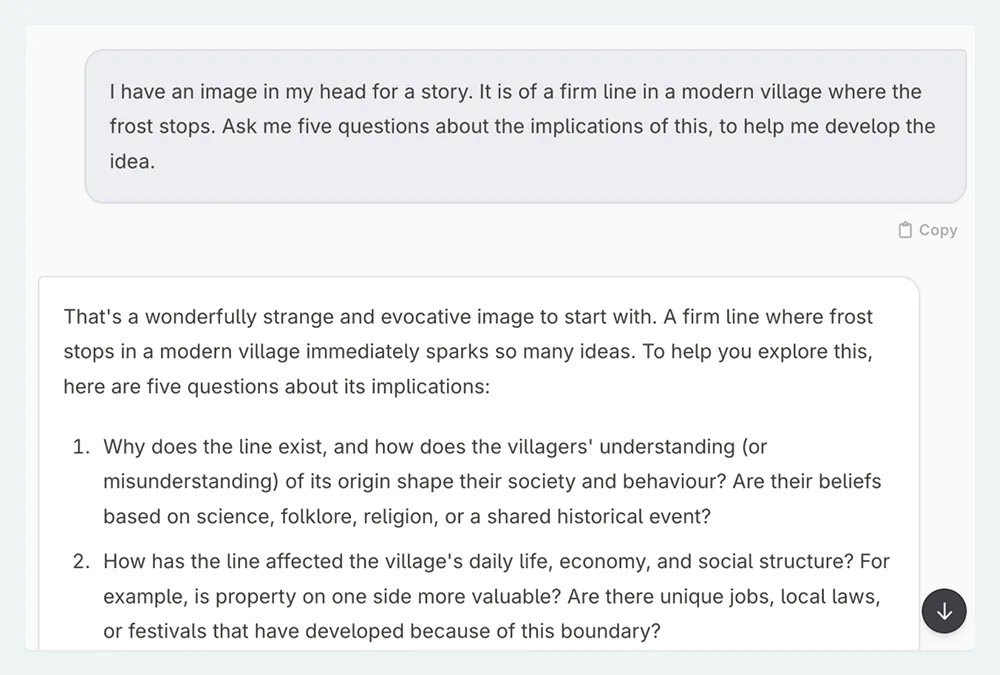
By answering these questions, you are the one doing the creative work. AI is simply a catalyst to deepen your own thinking.
If you want a little more guidance through the process, here is a handy preset we’ve made for you:
Socratic Brainstorming Prompt
Learn how to add this prompt to your account here.
The Result: A Messy List
After a brainstorming session, your page might be filled with a list of unrelated ideas. Here is mine:
A firm boundary in the village where frost stops. Cat statues that are guardians. A romance between a florist and a gravedigger. There is a void in the back of your washing machine. A detective who can taste emotions. “I didn’t say I killed him, I said I ended him.” Mid-Fantasy. Cyberpunk Western. A pirate who is torn between their love of the sea, (and freedom), and the dryad that they meet.
It is perfectly fine that none of these are complete stories (or even premises) yet. They are just sparks, the raw material for future projects.
Recap
In this lesson, we focused entirely on gathering ideas. We talked about creating a judgment-free zone to capture ideas and explored techniques like ‘What if’ Questions, Genre Mash-ups, and Partnering with AI to generate a long, messy list of story sparks.
In the next lesson, we’ll enter the Analyzing phase. We’ll take our messy list and learn how to sort it, finding the ideas that are ready to grow into something more.
This lesson was taught by:

Kate
Based in the UK, Kate has been writing since she was young, driven by a burning need to get the vivid tales in her head down on paper… or the computer screen.